
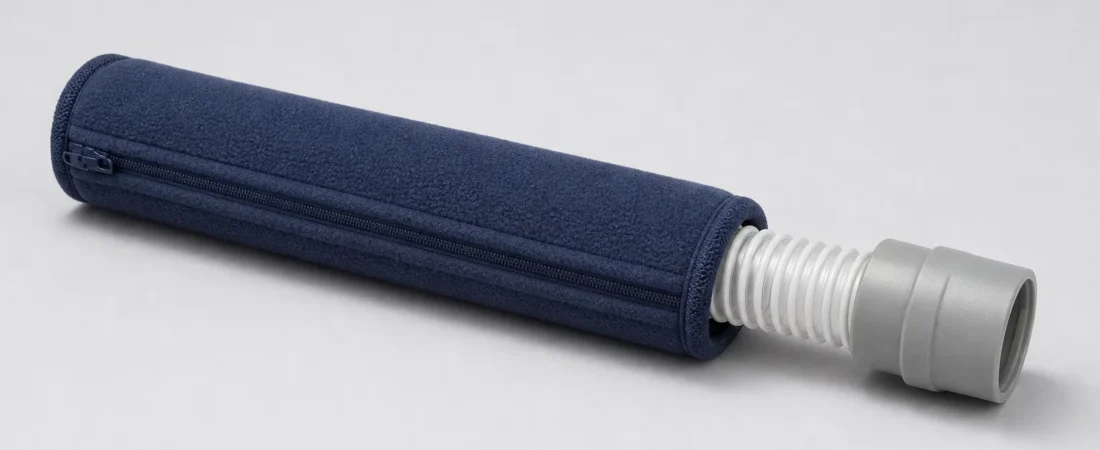
Heated tubing is the one CPAP accessory where a cover that looks right can still be wrong. The tube carries its own heating element, the connectors are larger than the tube, and the last few centimetres behave differently from the rest of the run. Getting the cover to fit is a measurement question before it is a product question.
Why heated tubing needs its own cover specification
A standard cover is specified against one number: the outer diameter of the tube. Heated tubing adds a second constraint, because the heated circuit terminates in a coupling that is wider than the tube itself and often warmer than the surrounding air. A cover cut to the tube diameter will not pass over that coupling, and a cover that runs right up to it leaves no room for the connector to sit.
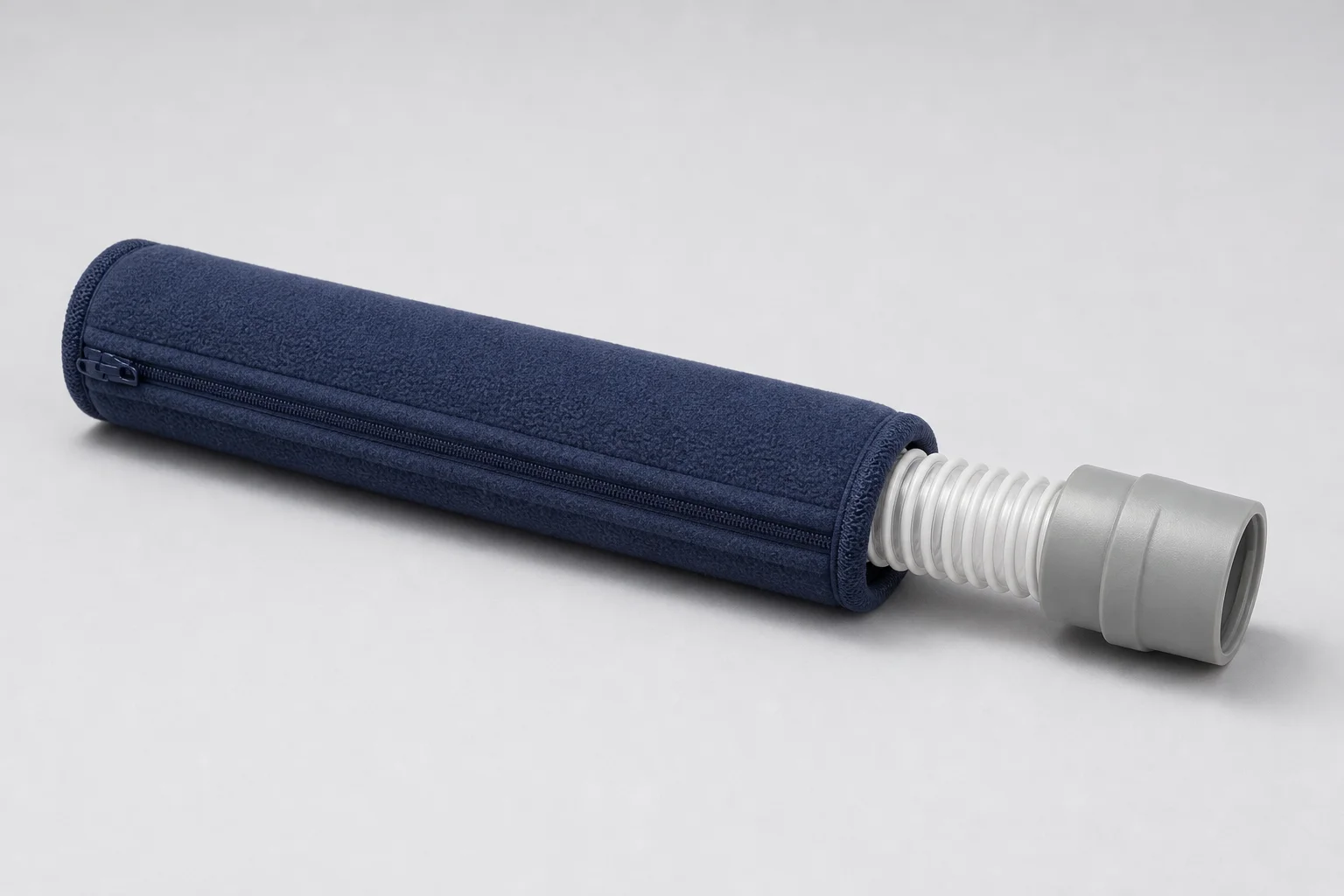
The working rule is that the cover stops short of the coupling and leaves a short ring of bare tube visible between the cover hem and the connector. That ring is deliberate. It keeps the fabric away from the electrical termination, it keeps the zip or hook-and-loop strip out of the way when the tube is connected and disconnected nightly, and it gives the user somewhere to grip.
Three measurements decide the fit
Take these off the tube the customer actually dispenses, not off a catalogue page.
1. Tube outer diameter. Heated tubing is commonly supplied in slim and standard formats. Measurement is taken on the corrugation, not on the smooth collar near the connector, because the cover has to slide over the ribs. If the diameter falls between the sizes you stock, size up: a cover that is slightly loose still insulates, a cover that is tight will not assemble in production.
2. Coupling diameter and length. Measure the widest point of the connector and how far it extends along the tube. This determines where the cover has to stop, and whether a standard length can be used or whether the cover needs to be shortened by a few centimetres. It is the number most often left out of an RFQ, and the one that causes the most returns.
3. Run length. Measure from the humidifier outlet to just below the mask connection, then subtract the clearance at each end. Specify the relaxed length plus the intended stretch for knit constructions, never the stretched length, or the cover will creep shorter in service.
Matching the three machine families on the market
Buyers usually arrive with a brand name rather than a measurement. ResMed, Philips and Fisher & Paykel heated systems do not share one tube geometry, and within each brand the heated and non-heated versions of the same machine use different tubing. The practical answer is to treat the brand as a starting point and confirm against the tube.
| What the buyer says | What to confirm before quoting | Cover format that usually fits |
|---|---|---|
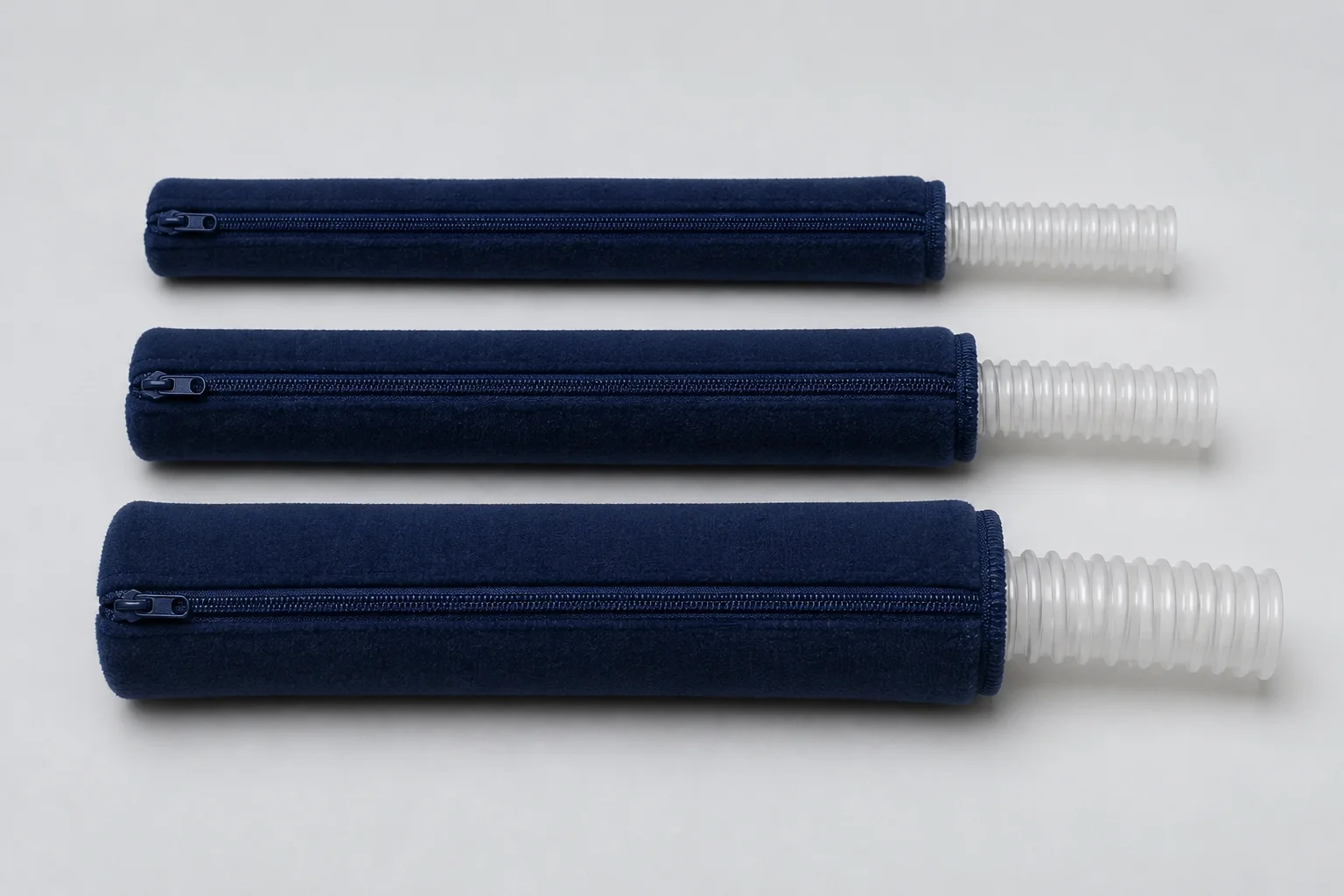
| “ResMed with heated tube” | Whether the tube is the slim heated type or the standard heated type; connector diameter and how far it protrudes | Slim zippered cover with a shortened run, or a heated-specific variant with extra coupling clearance |
| “Philips with heated tube” | Same two numbers, plus whether the machine end uses a detachable connector that must stay exposed | Zippered cover stopping short of the coupling; short mask-end sleeve for the exposed tail |
| “Fisher & Paykel heated” | Outer diameter at the corrugation and the total run length | Standard-diameter zippered cover, length matched to the run |
The table is a starting position, not a compatibility guarantee. Two machines sold under the same brand can take different tubing, and buyers change tubing between orders. A five-minute fit test on the actual tube before tooling is cheaper than a season of returns, and it is the reason we ask for the tube brand and model with every RFQ.
Where heated covers go wrong in production
The failures are consistent. A cover built to the exact tube diameter is difficult to assemble and strains at the seam once the heating element adds stiffness. A cover with a full-length zip that runs to the very end catches on the coupling every time the user reconnects. A cover in a heavy fleece on a slim heated tube adds bulk where the user is already managing a connector and a mask.
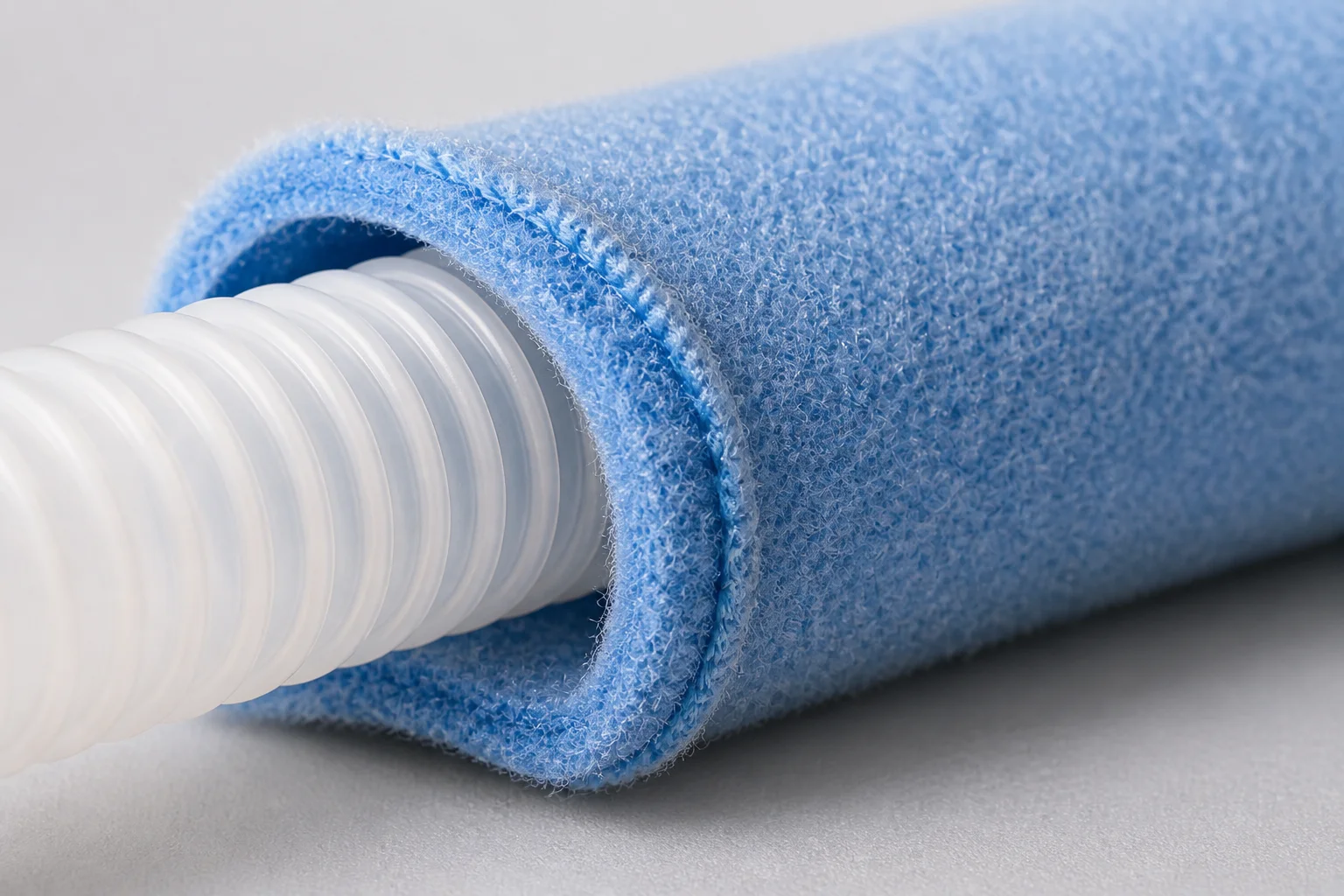
Two design choices remove most of that risk. Specify a few millimetres of internal clearance and let the closure take up the difference. And decide the closure before the length: a full-length zip costs more and takes longer to fit; a hook-and-loop strip is faster to use but breaks the silhouette; a stretch knit with no closure is the quickest to pack and the least tolerant of a diameter error.
Ordering: what to send with the RFQ
An RFQ that produces a usable quote within a day contains four things: the tube brand and model, the measured outer diameter, the coupling diameter and length, and the run length. Add the closure preference and the target retail price band if the program is private label.
On our side that converts into a sample plan rather than a price list. Typical programs run from 100 to 1,000 pieces depending on size and colour, MOQ is negotiable across the range, and a fit sample on your own tubing is standard before tooling. Lead time is confirmed on the offer and rush orders can be arranged. If the tube is one we have not seen, the sample is the fastest way to settle it.
Check the tube against our compatibility page before you specify, and see the heated-tubing format on the 6 ft heated-tubing zippered cover and the shorter 15 in mask-end zipper sleeve. If you are still choosing between a cover and heated tubing itself, the comparison in Heated Tubing vs an Insulated Cover covers where each belongs.
What buyers get wrong most often
Four mistakes account for most of the heated-tubing problems we see in the first order.
Measuring the smooth collar. The diameter is read on the corrugation, not on the collar near the connector. The two numbers differ by several millimetres, and the cover has to pass over the ribs.
Ordering by brand instead of by tube. A brand name identifies a family of machines, not a tube. Two units from the same range can leave the factory with different tubing, and the customer’s own replacement stock may differ from what shipped with the machine.
Forgetting the mask-end tail. On heated systems the unheated section between the cover and the mask is exactly where condensation still forms. A short sleeve for that run is often a better second SKU than a longer main cover.
Quoting the stretched length. Knit covers are ordered at their relaxed length. A length that only reaches the target when pulled will settle shorter after a few washes.
Not sure which cover fits your heated tube?
Send the tube brand and model, the measured outer diameter, the coupling size and the run length. We reply with a fit recommendation and a sample plan within one business day.
This article is general product education and is not medical advice. Patients should discuss therapy settings with their clinician.