What rainout actually is
A humidifier adds moisture to the air before it leaves the machine. That air is warm and saturated, and as it travels down the tube it loses heat to the room. Once the tube wall drops below the dew point of the air inside, the moisture condenses on the inside of the tube and collects in the low points of the run.
By the time it reaches the mask end, that water arrives as gurgling, a wet hiss, or droplets that wake the user up. From a buyer side, rainout is the single most common reason a hose cover gets added to an order.
What a hose cover changes - and what it does not
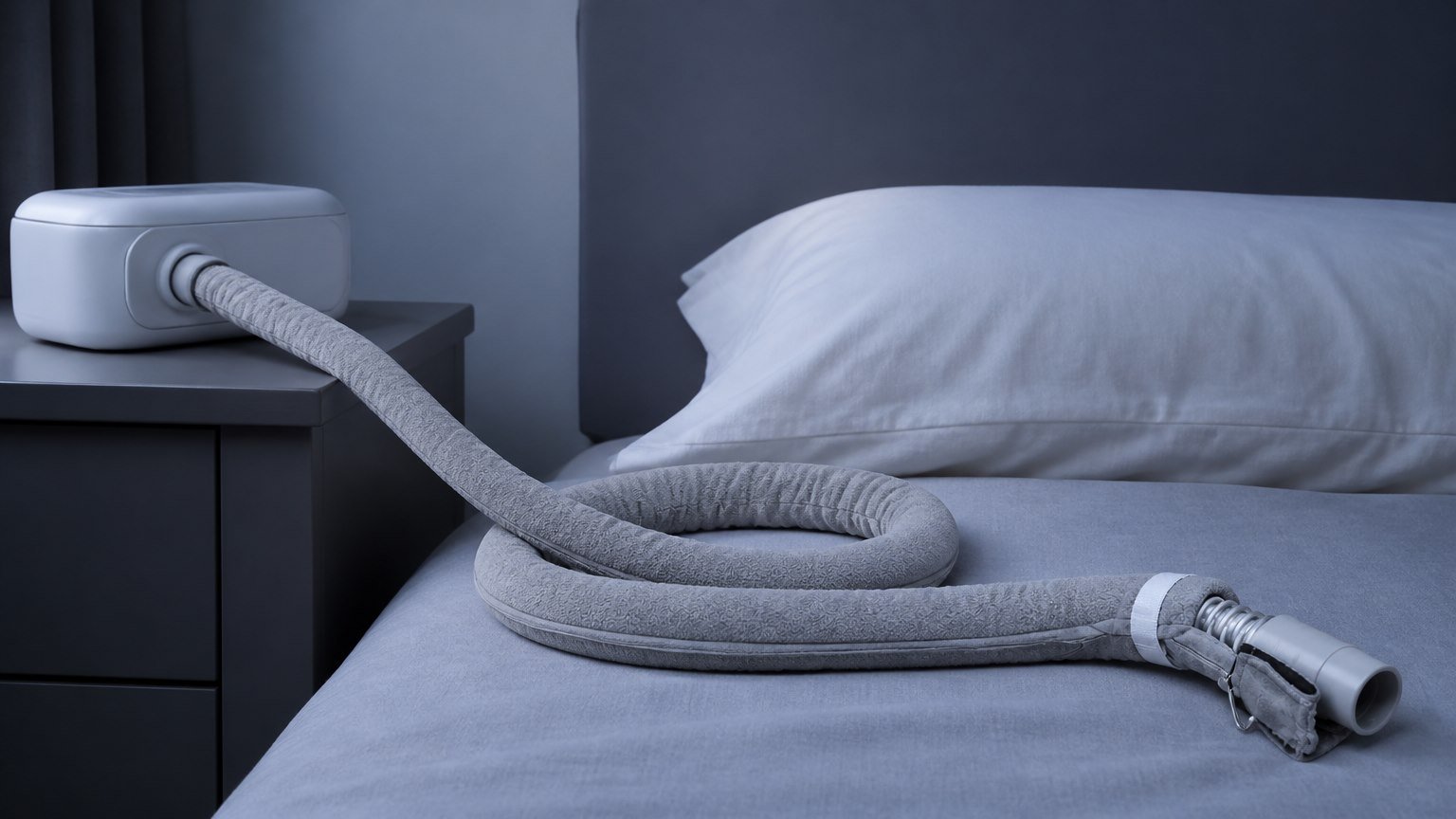
A fleece cover is passive insulation. It does not heat the tube; it slows the rate at which the tube loses heat to the room, which raises the tube wall temperature a few degrees above the room and reduces the amount of condensation that forms.
It does not eliminate rainout in every setup. In a very cold bedroom, or with a high humidity setting, insulation alone may not be enough, and the fixes below are worth combining.
Five fixes, in the order worth trying
1. Raise the room temperature slightly. Condensation is driven by the gap between the air inside the tube and the room outside it; the smaller the gap, the less water forms.
2. Insulate the tube. A cover keeps the tube wall warmer along its whole run and is the lowest-effort hardware fix.
3. Place the machine below mattress level. Gravity then drains any condensate back toward the humidifier instead of along the tube toward the mask.
4. Take the humidifier setting down one step and see whether the dryness is still comfortable.
5. Elevate the tube with a support so there are no low points for water to pool in.
Choosing the cover that fits the tube you have
Match the cover to the tube, not to the machine. Two numbers matter: the length of the run and the outside diameter of the tube at its thickest point.
Standard tubing is about 22 mm and slim tubing around 15 mm. Heated tubing carries an electrical connector and is thicker at the cuff than a standard tube, so a cover cut for 22 mm can be tight over it. Measure the cuff and order against that figure.
For length, 6 ft covers the common run; 8 ft and 10 ft covers exist for machines placed further from the bed, and a short sleeve suits the mask end of the tube.
Care that keeps the cover working
Wash the cover on a cold gentle cycle with a mild detergent and let it air dry away from direct sun. Wash it together with the tube so both stay fresh, and avoid fabric softener, which coats the fleece pile and reduces its loft.
Buying these covers
Covers are produced to order in 6 ft, 8 ft and 10 ft lengths, in standard 22 mm, slim 15 mm and heated-tubing cuts, with a zipper or hook-and-loop closure. Send the tube measurement and target quantity for a quotation.
Request a Quote